
Center for Reproductive Medicine & Robotic Surgery (St. Louis): Patient Guide
St. Louis has quietly become one of the Midwest's most competitive markets for fertility care. The city is home to several well-regarded clinics, each with a distinct clinical identity. Patients familiar with this editorial series will know that we have already covered the Infertility Center of Saint Louis, founded by microsurgical pioneer Dr. Sherman Silber — a program defined by deep research roots and an unusually broad surgical repertoire. The Center for Reproductive Medicine & Robotic Surgery, operating under the brand name GoFertility and located in the Creve Coeur neighborhood at 844 North New Ballas Court, occupies a different but equally compelling niche. Its differentiating feature is the combination of a high-performing IVF laboratory — one that has bested national success rate benchmarks every year since the clinic opened in 2011 — with a robust robotic surgery program led by a physician who is also a certified national trainer in minimally invasive gynecological procedures. For patients whose infertility has a structural or anatomical component, that combination is worth understanding in detail.
Physicians and Clinical Team
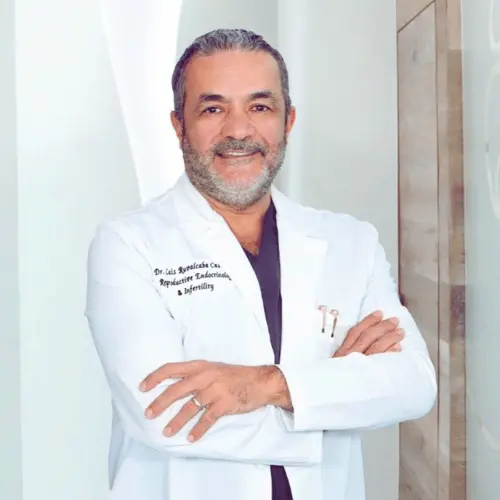
The clinic's founder, medical director, and sole attending physician is Dr. Saji Jacob, M.D., HCLD (ABB), FACOG. His credential string reflects a deliberately built skill set that spans three disciplines: reproductive endocrinology, clinical embryology, and advanced gynecological surgery.
Dr. Jacob completed his M.B.B.S. at the University of Kerala in India before pursuing obstetrics and gynecology residency training at Washington University in St. Louis School of Medicine — one of the most competitive programs in the country. He then undertook a three-year fellowship in Reproductive Endocrinology and Infertility at the Royal College of Surgeons in Ireland and Rotunda Hospital in Dublin, supplemented by a fellowship in clinical embryology and a Diploma in Gynecology and Obstetrics from the University of Kerala, and a Diploma in Health Informatics from the University of Dublin.
What sets Dr. Jacob apart from many REI specialists is a second board certification: he is credentialed by the American Board of Bioanalysis as a High Complexity Clinical Laboratory Director (HCLD), a designation he earned in 2018. Only a small number of physicians in the United States hold dual board certification in reproductive endocrinology and high-complexity laboratory direction. This means Dr. Jacob is not simply overseeing a lab run by a separate embryologist — he is directly responsible for the technical direction of the laboratory at the same level as the clinical care, a structural integration that he and the clinic credit for consistently above-average outcomes.
Dr. Jacob also holds membership in the Royal College of Obstetricians and Gynecologists (UK), serves as a clinical assistant professor of OB/GYN at Washington University in St. Louis, and has received the Organon Resident Research Award. He is a credentialed national proctor for robotic gynecological surgery, meaning he travels to other hospitals to train practicing physicians in robotic procedures — a role that underscores the level of technical expertise he has accumulated since the clinic opened.
Services and Treatments
GoFertility offers a full spectrum of fertility and gynecological care. On the reproductive side, the core treatments include:
IVF and ICSI: Standard in-vitro fertilization with intracytoplasmic sperm injection is the clinic's flagship offering. Both fresh and frozen embryo transfer cycles are available, and the lab supports all standard embryo culture protocols.
IUI and Ovulation Induction: Intrauterine insemination with or without ovulation stimulation is available for patients at earlier stages of treatment or with mild male-factor infertility.
Egg Freezing and Embryo Preservation: Elective egg freezing and fertility preservation are offered for patients facing medical treatment that may affect ovarian function, or those who wish to delay childbearing. The clinic was actively recruiting egg donors for its 2026 program at the time of this writing.
Male Infertility: Percutaneous Epididymal Sperm Aspiration (PESA) and Testicular Sperm Aspiration (TESA) are available for patients with azoospermia or obstructive male-factor infertility, providing sperm for use in ICSI cycles.
Egg Donation: A coordinated egg donation program is in place for patients who require donor oocytes due to diminished reserve, premature ovarian insufficiency, or genetic concerns.
Gynecological Services: Beyond fertility treatment, the clinic provides hormone replacement therapy, well-woman exams, and diagnostic services including DXA bone density scanning and body composition analysis — a scope that makes GoFertility suitable as an ongoing gynecological home for patients before, during, and after fertility treatment.
Patients researching the full treatment landscape can review our IVF guide for an explanation of how stimulation protocols, retrieval, and embryo transfer work across different clinic settings.
Robotic Surgery for Fertility
The second half of the clinic's name is not marketing language — it reflects a genuine surgical program that treats structural causes of infertility through minimally invasive robotic-assisted procedures. Dr. Jacob uses the da Vinci Surgical System and has completed more than 1,000 robotic surgeries since the clinic opened in 2011.
The conditions treated through this program include endometriosis (including advanced-stage cases), uterine fibroids (myomectomy), ovarian cysts, and obstructed fallopian tubes requiring microsurgical reanastomosis. Robotic hysterectomies are also performed when clinically appropriate.
The rationale for robotic surgery in a fertility context is significant. Endometriosis is estimated to affect up to 60 percent of women presenting with infertility — and many of those cases involve scar tissue or lesions that impair the function of the ovaries, fallopian tubes, or uterus. Surgical correction, when performed with sufficient precision, can restore anatomy and improve the odds of both natural conception and assisted reproduction. The robotic platform offers a 3D magnified view of the surgical field, instrument movement that filters out the natural tremor of a human hand, and incision sizes typically under one inch — resulting in less blood loss, reduced post-operative pain, and recovery times measured in days rather than weeks.
Dr. Jacob's national trainer role means that the procedures performed at GoFertility are not simply being executed by a competent robotic user — they are being performed by someone who teaches the technique to other surgeons across the country. Patients with complex anatomical presentations, prior failed surgeries, or advanced endometriosis may find this level of surgical expertise particularly relevant to their care.
GoFertility's robotic surgery program overview provides additional detail on which conditions are amenable to robotic treatment and what patients can expect in terms of recovery.
Laboratory and Success Rates
The GoFertility laboratory carries CLIA certification and CAP accreditation through the Reproductive Laboratory Program of the College of American Pathologists — the gold standard for fertility laboratory oversight in the United States. Dr. Jacob's HCLD credential means the same physician directing your clinical care is also directly accountable for the laboratory protocols that govern how your embryos are handled.
The outcomes data reflects this investment. GoFertility has been ranked among the top 50 IVF centers in the United States for three consecutive years, a distinction noted by Newsweek. More granularly, the clinic's pregnancy-per-embryo-transfer rate has exceeded the national average every year since opening. In 2015 that rate was 76 percent; by 2017 it had risen to 81 percent; following Dr. Jacob's HCLD certification in 2018, it reached 88 percent for the 2019 reporting period. For context, the national average pregnancy rate per embryo transfer has hovered between 30 and 40 percent during the same timeframe. Prospective patients should note that success rates vary by age, diagnosis, and treatment type, and these figures should be interpreted alongside individualized consultation.
Considering At-Home Insemination?
Not every fertility journey begins in a clinic. At-home intracervical insemination (ICI) is a lower-cost, private option that suits patients with no known fertility diagnosis — including single parents by choice, same-sex couples, and people who want to try a few cycles before committing to clinical treatment.
At-home insemination kits like those from MakeAMom come with step-by-step instructions designed for donor or partner sperm. Kits are a one-time purchase that can be reused until conception succeeds, require no clinic visit, and arrive in plain, discreet packaging. Many patients use them as a first step while working toward a fertility consultation — or alongside ovulation tracking while they wait for an appointment slot.
If you have a known fertility diagnosis, have been trying for 12 months without success (six months if you're over 35), or your physician has already recommended IUI or IVF, a board-certified reproductive endocrinologist is the right next step.
Insurance and Financing
Missouri has no state mandate requiring insurers to cover IVF or other fertility treatments, which means coverage depends entirely on the specific terms of each patient's health plan. GoFertility accepts a wide range of insurance carriers including Aetna, Cigna, Humana, Health Link, GEHA, Tri-Care West, Medicare, Medicaid, and Missouri HealthNet. Patients with employer-sponsored plans not listed should contact the clinic directly to verify coverage, as networks shift frequently.
For self-pay patients or those with limited coverage, the clinic offers financing options to help spread the cost of treatment. Given Missouri's absence of an IVF mandate, patients comparing costs across fertility clinics in Missouri should factor in not just per-cycle fees but also what diagnostic workup, surgical consultations, and embryology services are bundled versus billed separately.
Frequently Asked Questions
What makes GoFertility different from other St. Louis fertility clinics? The most distinctive feature is the integration of a robotic surgical program with a high-performing IVF laboratory under a single physician who holds dual board certifications in reproductive endocrinology and high-complexity laboratory direction. This structure is relatively rare nationally and may be particularly relevant to patients with endometriosis, fibroids, or other structural factors contributing to their infertility.
Does GoFertility treat male infertility? Yes. The clinic offers PESA and TESA for sperm retrieval in cases of azoospermia, with retrieved sperm used in ICSI cycles. Male-factor infertility evaluation is part of the standard diagnostic workup for couples presenting with difficulty conceiving.
How quickly can patients typically recover from robotic surgery? Recovery timelines vary by procedure, but patients undergoing robotic myomectomy or endometriosis resection at GoFertility typically resume normal activities within 10 days. The minimally invasive approach — with incisions under one inch — results in significantly shorter recovery compared to open surgical techniques.
Is GoFertility accepting new patients for 2026? Yes. The clinic is actively accepting new patients and was recruiting egg donors for its 2026 donor program at the time of publication. New patients can register through the patient portal on the GoFertility website or contact the office directly at (314) 473-1285.