
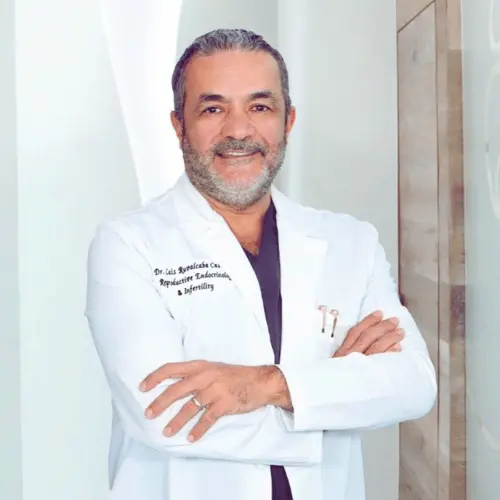
Kentucky Fertility Institute (KFI) has built a regional reputation that extends well beyond Louisville—drawing patients from across the Commonwealth and from Southern Indiana across the Ohio River. Located at 4612 Chamberlain Lane in northeast Louisville, KFI operates as a boutique clinic: a single physician-director who personally performs most procedures, lab operations headed by a credentialed PhD embryologist, and a small, tightly coordinated team. In a state with no IVF insurance mandate and a limited number of reproductive specialists, that combination makes KFI one of the most prominent fertility destinations in Kentucky.
Physicians and Clinical Team
The practice is led by Dr. Robert K. Hunter II, MD, FACOG, who serves as Practice Director and the clinic's primary reproductive endocrinologist. Dr. Hunter completed his undergraduate studies at Emory University in Neuroscience and Behavioral Biology, earned his MD at AUC School of Medicine, and completed his residency in Obstetrics and Gynecology at Staten Island University Hospital. His subspecialty training—a fellowship in Reproductive Endocrinology and Infertility—was completed at the University of Louisville, the same institution where he later earned dual advanced degrees: a Master of Science in Public Health and an MBA.
Dr. Hunter is double board-certified by the American Board of Obstetrics and Gynecology (ABOG) and holds the ABOG Practice Focus Designation in Minimally-Invasive Gynecologic Surgery—a distinction held by only a handful of fertility specialists nationally. He belongs to the American Society for Reproductive Medicine (ASRM), ACOG, and RESOLVE: The National Infertility Association. He also established the first fertility preservation partnership with a National Women's Soccer League team, a model later adopted across professional women's sports.
Supporting Dr. Hunter are Bianca Weaver, NP (consultations and monitoring), Yllena Novitsky (Clinical Manager), and Paige Hardin-O'Brien (embryologist). The laboratory is directed by Dr. Greg Christensen, PhD, HCLD—the High Complexity Laboratory Director credential being the gold standard for IVF lab oversight.
Services and Treatments
KFI offers a comprehensive range of assisted reproductive technology (ART) services suited to a wide spectrum of patients—from those just beginning diagnostic workups to those arriving after unsuccessful cycles elsewhere.
Diagnostic services span ovulation testing, pelvic ultrasound, hysterosalpingography (HSG), ovarian reserve testing, saline-infusion sonography (SIS), hormone panels, and endometrial biopsy for women, plus semen analysis, sperm DNA fragmentation, and genetic testing for male partners.
Core treatment pathways include:
- Intrauterine Insemination (IUI): A lower-cost, lower-intervention first-line treatment involving placement of washed, concentrated sperm directly into the uterus at the time of ovulation.
- In Vitro Fertilization (IVF): KFI is a SART-member clinic, meaning it reports outcome data to the Society for Assisted Reproductive Technology. The clinic positions IVF as its flagship service and publishes success rates through the SART national database.
- Preimplantation Genetic Testing (PGT): Available for aneuploidy screening (PGT-A) and for patients with known genetic conditions (PGT-M), helping improve the odds of a healthy live birth and reducing miscarriage risk.
- Egg Freezing / Fertility Preservation: KFI has a particular institutional emphasis here, given Dr. Hunter's background in fertility preservation for athletes and oncology patients. The clinic also offers oncofertility services for patients facing cancer treatment.
- Donor Egg IVF: For patients with diminished ovarian reserve or prior IVF failures, KFI coordinates donor egg cycles.
- Surrogacy: The clinic works with gestational carriers and assists in matching, legal coordination referrals, and the embryo transfer component.
- LGBTQ+ Family Building: KFI actively serves same-sex couples and single parents by choice, with experience in reciprocal IVF and donor sperm protocols. Patient reviews specifically praise Dr. Hunter for advocating on behalf of LGBTQ+ couples throughout the treatment process.
For a deeper look at how IVF works from stimulation through embryo transfer, see our IVF guide.
Laboratory and Success Rates
The embryology laboratory is the engine of any IVF program, and KFI has invested in credentialed leadership at that level. Dr. Greg Christensen's HCLD designation means laboratory protocols are held to rigorous external standards. KFI is a SART-reporting member, and its outcome data for the most recent reporting cycle is publicly available through the SART national database, which allows prospective patients to review live birth rates by age group and cycle type in a standardized format.
As a boutique single-physician program, KFI's cycle volumes are lower than those at large multi-physician urban centers. Lower volume means more direct physician involvement in every case; prospective patients comparing clinics should review SART data to contextualize outcomes relative to patient mix and age demographics.
Patient Experience
KFI earns consistently high marks on FertilityIQ, Healthgrades, and Birdeye. Recurring themes include:
- Direct physician access: Dr. Hunter is known for responding to patient questions via email and for explaining treatment rationale at each step rather than delegating communication entirely to staff.
- Unhurried consultations: Patients describe appointments as thorough, with time given to questions without feeling rushed—a stark contrast to the assembly-line experience some report at larger regional programs.
- Team cohesion: Every staff member—from the front desk to the embryology suite—is described as invested in patient outcomes. The phrase "treated like family" appears across independent review sites with enough consistency to carry credibility.
- Honest counseling: Dr. Hunter is praised for presenting realistic success probabilities and not directing patients toward treatment they are not ready for.
Where critical feedback appears, it tends to center on billing processes—a common friction point at smaller practices.
Considering At-Home Insemination?
Not every fertility journey begins in a clinic. At-home intracervical insemination (ICI) is a lower-cost, private option that suits patients with no known fertility diagnosis — including single parents by choice, same-sex couples, and people who want to try a few cycles before committing to clinical treatment.
At-home insemination kits like those from MakeAMom come with step-by-step instructions designed for donor or partner sperm. Kits are a one-time purchase that can be reused until conception succeeds, require no clinic visit, and arrive in plain, discreet packaging. Many patients use them as a first step while working toward a fertility consultation — or alongside ovulation tracking while they wait for an appointment slot.
If you have a known fertility diagnosis, have been trying for 12 months without success (six months if you're over 35), or your physician has already recommended IUI or IVF, a board-certified reproductive endocrinologist is the right next step.
Insurance and Financing
Kentucky has no state IVF insurance mandate, meaning costs fall on patients and whatever voluntary employer coverage exists—a meaningful contrast to mandate states like Illinois or Massachusetts.
KFI acknowledges this landscape directly and provides financial support guidance for patients. Common options include fertility-specific financing through third-party lenders such as CapexMD or LightStream, FSA/HSA funds for diagnostics and procedures, and multi-cycle packages that reduce per-cycle cost exposure. Patients should also audit their employer benefits carefully: a growing number of companies have added fertility coverage through platforms like Progyny or Maven, even in states without a mandate.
For a state-by-state breakdown of where fertility coverage mandates apply, see our guide to fertility clinics in Kentucky.
Frequently Asked Questions
Does Kentucky Fertility Institute accept patients from outside Louisville? Yes. KFI's service area includes Lexington, Bowling Green, Bardstown, and Southern Indiana communities across the Ohio River. Patients traveling from a distance often consolidate monitoring visits, and the team can discuss coordination with referring OB/GYNs.
What is the first step to becoming a patient at KFI? An initial consultation with Dr. Hunter typically kicks off a baseline workup—AMH, FSH, and estradiol bloodwork; a pelvic ultrasound for antral follicle count; and a semen analysis for male partners. Contact the clinic at (502) 996-4480 or through kentuckyfertility.com.
How do I access KFI's IVF success rates? KFI reports outcome data to SART annually. Search for "Kentucky Fertility Institute" in the SART Clinic Summary Report tool to view the most recent live birth rates broken down by age group and cycle type.
Does KFI treat LGBTQ+ patients and single parents by choice? Yes. The clinic lists LGBTQ+ family building as a core service area, with documented experience in reciprocal IVF for female same-sex couples and donor sperm protocols for single women. Patient reviews specifically highlight Dr. Hunter's willingness to advocate for LGBTQ+ patients throughout the treatment process.